Monday, April 29, 2013

Another analog to the Doors of Durin

A few months ago, after long gestation, I made a comparison between Tolkien’s illustration of the Doors of Durin and a Jewish parokhet at a synagogue in China. As I said then, we have no reason to expect this image inspired Tolkien; the similarity is striking, but is almost certainly coincidental. There is a more definite analogy between the Jews and the Dwarves — Tolkien admitted that much — but the imagery of this particular Ark of the Torah was surely a random similarity. What seems more likely is that similar arrangements of arches, crowns, columns, etc., were a commonplace on which Tolkien drew. Likely enough a medieval one.

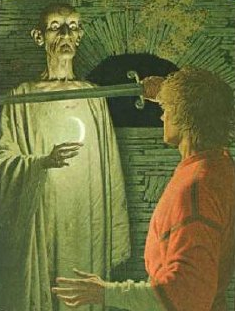
Well, you can imagine my surprise when I happened to see a copy of Heroes & Kings for sale on eBay. This is a collection of poems Charles Williams, published in London by The Sylvan Press, 1930. It’s also very rare — only 300 copies were printed (of which only 250 were offered for sale) — which explains the high asking price of this auction. The decoration on the cover looks rather familiar, doesn’t it? Very much like Tolkien’s Doors of Durin, with the addition of a sword.

Now, again, I am not suggesting this decoration influenced Tolkien. I don’t have any reason to think he ever saw it. Tolkien did not meet Charles Williams until 1939, and he did not particularly appreciate his creative output. “I had read or heard a good deal of his work,” he later wrote, “but found it wholly alien, and sometimes very distasteful, occasionally ridiculous” (Letters, #276). Elsewhere, he wrote, flat-out, that “I do not think we influenced one another at all!” (Letters, #159). Might Tolkien be overstating his case? This decoration is certainly much closer to him than the Jewish parokhet. Tolkien might have seen this work,  even though it was published in only 300 copies more than a decade before. But it’s a very big maybe. Even if he did, is it likely this image stuck in his head and came out again a decade later in the Doors of Durin? It doesn’t seem very likely. Unless further evidence should come to light, the more probable explanation for this similarity is that both Tolkien and Norman Janes or Hubert Foss were merely drawing water from the same well (Janes made the woodcuts in Heroes & Kings; Foss was the book designer).

But once again, it is certainly a fascinating coincidence!

Friday, March 15, 2013

The C.S. Lewis and Inklings Society Conference

Once again, with Easter on the horizon, it’s time for another C.S. Lewis and Inklings Conference. This is their 16th annual gathering, and the sixth I’ve attended. This time, the conference is being hosted by Le Tourneau University in Longview, Texas, during the weekend of 21–23 March 2013, with variations on the theme, “Fairytales in the Age of iPads: Inklings, Imagination, and Technology”. If I still lived in Dallas, this would have been the closest one yet — only a two-hour drive. But since I’ve moved to Washington, it’s now the furthest one yet.

But I had to attend. Not only is it a wonderful event, a chance to see old friends, and a chance to return to Dallas to see a completely different set of old friends, but — and I’ll try to feign some decorum and an appropriate sense of modest embarrassment at this — I’ve won their first prize for best scholar essay again. That’s right. Best in Show four years in a row, every year, in fact, that the prize has been given. So I simply couldn’t refuse the honor. :)

For anyone who might be in the area, it’s not too late to join us. Dr. Ralph Wood is the guest of honor and will be giving two plenary speeches, one of C.S. Lewis and one on J.R.R. Tolkien. The rest of the schedule (somewhat abbreviated here; follow this link for the whole thing) looks to be just as good. And by the way, my vote for best paper title definitely goes to “The Palantír Stones as Sauron’s Social Media: How to Avoid Getting Poked by the Dark Lord”. Bravo!


THURSDAY EVENING, MARCH 21, 2013

Film: The Fellows Hip: Rise of the Gamers

FRIDAY MORNING, MARCH 22, 2013

Plenary Session 1
Dr. Ralph Wood, Professor of Theology & Literature, Baylor University
“A Long Obedience in the Right Direction: J.R.R. Tolkien on Adventures and Quests”

Section A: Inklings and Social Technology
“Electric Fairy Tales: The Importance of Mythopoetic Thought in the Age of New Media”, Jeremy Johnson, Goddard College
“The Palantír Stones as Sauron’s Social Media: How to Avoid Getting Poked by the Dark Lord”, Philip Fitzsimmons, Southwestern Oklahoma State University
“Is There Death in the [iPad]? The Influence of iPads on Us as Sub-Creators”, Joshua Boyd, Baylor University

Section B: Inklings and Film
The Fellows Hip: Rise of the Gamers — An Adaptor’s View of Tolkien Adaptation”, Cole Matson, University of St. Andrews
“Divine Intervention, CGI, and the Mythopoeic Aesthetic in Peter Jackson’s The Lord of the Rings Trilogy”, Jim Stockton, Boise State University
“Whiner or Warrior? Susan Pevensie’s Role in Novel and Film Versions of The Chronicles of Narnia”, Dr. Eleanor Hersey Nickel, Fresno Pacific University

FRIDAY AFTERNOON, MARCH 22, 2013

Plenary Session 2
Dr. Ralph Wood, Professor of Theology & Literature, Baylor University
“C.S. Lewis and Theosis: The Christian Life as Divinization in The Great Divorce

Section C: Myth and Modern Life
“Tales from Eternity: Fairy Tales as ‘Equipment for Living’”, Dr. William Epperson, Oral Roberts University
“The Gold is God’s, Wherever It Is Found: An Augustinian Reading of J.R.R. Tolkien’s Poem ‘Mythopoeia’”, Jeremy Larson, Baylor University
“Lev Grossman’s The Magicians: Narnia Under Fire?”, Dr. Amanda Himes, John Brown University

Section D: Technology, Creation, and Consumption
“Men, Machine, and Mortality in Dorothy L. Sayers The Nine Taylors”, Denise Galloway Crews, Baylor University
“Tinkering with the God in the Machine: Technology and Consumption in The Lord of the Rings”, Corbin Lockmiller, University of Texas, Arlington
“Techne — to Create or Destroy: J.R.R. Tolkien’s Lord of the Rings — the New iPhone 5”, Dr. Harvey Solganick, The College at Southwestern Baptist Theological Seminary

Section E: Education, Reading, and Modernity in C.S. Lewis
“Not a Tame Lewis: Towards Putting Lewis into Conversation with Postmodernism”, Michael Muth, Wesleyan College
“The Abolition and Preservation of Man”, Dr. David Rozema, University of Nebraska at Kearney
“C.S. Lewis on Self Transcendence Through Reading”, Aaron Cassidy, Texas Woman’s University

Section F: The Mind, the Soul, and the
“The Mind Plays Tricks: Remembering God with C.S. Lewis and St. Augustine”, David Smith, Baylor University
“Representations of the Tripartite Soul in Lewis’s Space Trilogy”, Dr. Hayden Head, College of the Ozarks
“‘The Shadow Knows’: The Doppelganger as a Literary Motif in the Works of George MacDonald and J.R.R. Tolkien”, Dr. Mark Hall, Oral Roberts University

Section G: Myth and Allegory
“Mythical Fact: C.S. Lewis’s Ideas on Mythology”, Sarah Clower, Hardin-Simmons University
“Orual’s Bildungsroman Through a Myth Retold in C.S. Lewis’s Till We Have Faces”, Ashley Simpson, Hardin-Simmons University
“Pattern of Leaves: Eucatastrophe and Allegory in Tolkien”, Carley Robinson, LeTourneau University

FRIDAY EVENING, MARCH 22, 2013

Banquet
Paper Contest Awards

SATURDAY MORNING, MARCH 23, 2013

Section H: Tales about the Tellers
“Lindskoog vs. Hooper (Part I)”, Dr. Joe R. Christopher, Tarleton State University
“C.S. Lewis’s Intense Dislike of T.S. Eliot: Truth or Fiction?”, Dr. Janice Brown, Grove City College

Section I: Tolkien as Philologist and Illustrator
“J.R.R. Tolkien: The Foolhardy Philologist”, Jason Fisher, Independent Scholar
“An Illustrious Illustrator: J.R.R. Tolkien as Artist and Calligrapher”, Kathryne Hall, Oral Roberts University

Section J: C.S. Lewis on Will, Emotion and Reason
“C.S. Lewis’s The Abolition of Man and Sylvan Tompkin’s Script Theory Psychology”, Dr. Larry E. Fink, Hardin-Simmons University
“Self Will and Emotion in Five of C.S. Lewis’s Works”, Rachel Bales, Hardin-Simmons University
“C.S. Lewis and the Art of Courtly Love”, Dr. Salwa Khoddam, Oklahoma City University

Section K: Tempation and Repentance
“Meeting the Best of Knowledge: The Spiritual Fate of Male and Female Academics in Two Novels of Charles Williams”, Dr. Keith Dorwick, the University of Louisiana at Lafayette
“The Psychology of Screwtape”, Kayla Hastings, Hardin-Simmons University
“Mr. Vane and Lilith: Two Roads to Repentance?”, Dr. Jonathan Himes, John Brown University

Section L: Inklings and The Environment
“Tom Bombadil and Treebeard: The Adaptation of Medieval Concepts of Nature in J.R.R. Tolkien’s The Lord of the Rings”, Dawn Martin, LeTourneau University
“The Green Mystic: Tolkien's Otherworldly Love of Trees”, Felipe Vogel, LeTourneau University
“George MacDonald and Ecology”, David L. Neuhouser, Taylor University

Tuesday, February 26, 2013

A new blog — Teaching Tolkien

From time to time, I have something to share about Tolkien in the classroom (this, for example, and this, and even this). Thus far, most of these posts have dealt with Tolkien in the college classroom. But what about secondary school or even primary school? Today, I wanted to share news of a new blog, Teaching Tolkien, which takes up that very issue. This is something I know you are all going to want to keep an eye on!

In the words of the blog’s founder, Holly Rodgers:
Teachingtolkien.com is designed to be a resource for educators who are looking for methods for sharing the works of J.R.R. Tolkien with their students. The lessons described on this site were used with elementary students in grades 5 and 6, who are ELL (English Language Learners). These students are classified as limited English-proficient under the requirements of NCLB (No Child Left Behind).
That’s right: Ms. Rodgers’s students are not only fifth and sixth graders, they’re students whose first language is not English. Not only are their cradle tongues not English, they aren’t even European. Her class of thirteen speaks an assortment of Asian languages, including Somali, Urdu, Punjabi, Arabic, Farsi, and Korean. This class, therefore, is not only a great test of the minimum reading age for Tolkien’s novels, but it should offer interesting insights into cultural reception of his themes and motifs as well. The results so far are very promising. After reading The Hobbit, Ms. Rodgers’s students clamored for The Lord of the Rings, on which they have now embarked.

Do give the blog a look, offer an encouraging comment, and wish Ms. Rodgers and her intrepid band of international literary explorers well. I was about the same age as these students when I first read Tolkien myself, as I suspect many of you were too. It’s wonderful to see teachers keeping that tradition alive.

Tuesday, February 19, 2013

Recent publications

Hello, friends. I come to you today with a few publication announcements. Two of my older works — one of them much older — have recently been published, and another one is in translation for forthcoming publication. Here are the details.

My essay, “Some Contributions to Middle-earth Lexicography: Hapax Legomena in The Lord of the Rings”, appears in the new issue of The Year’s Work in Medievalism. The year in question is 2011, but the issue has been delayed until now. In fact, I haven’t seen it yet, but I expect my copy to arrive any day now. The issue, edited by E.L. Risden of St. Norbert College, includes several other very interesting-sounding papers. You can see the full table of contents here. This essay was originally written for the Scholars Forum on The Lord of the Rings Plaza (read it here), at the request of David Gransby (aka halfir), who, sadly, passed away last summer. He was a good friend — although we never met in person, since he lived in Thailand — and I would like to dedicate the publication of this essay to his memory.

About a year ago, I shared news that one of my essays had been translated into French for a special number of L’Arc et le Heaume, the journal of the French Tolkien Society, Tolkiendil. I’m very happy to report that the essays originally written in English and translated for the special anniversary issue are now available (in English) on the Tolkiendil website. Follow this link to read essays by Ted Nasmith, John D. Rateliff, Tom Shippey, Thomas Honegger, and of course, yours truly. Coincidentally, all the scholars named here were also contributors to my book!

And last but not least, more news from Tolkiendil. As some of you may know, the Society published a collection of essays last year called Tolkien, le façonnement d’un monde, Vol. 1: Botanique et Astonomie, edited by Didier Willis. Learn more about it here. Didier is now at work on a second volume, hopefully to be published this year. In addition to including a French translation of Kristine Larsen’s essay, “Sea Birds and Morning Stars: Ceyx, Alcyone, and the Many Metamorphoses of Eärendil and Elwing”, which was published in my book, Tolkien and the Study of His Sources (McFarland, 2011), the collection will include a translation of my own essay, “‘Circles of the World’: Speculations on the Heimskringla, the Latin Vulgate Bible, and the Hereford Mappa Mundi”, originally published in Middle-earth and beyond: Essays on the World of J.R.R. Tolkien (ed. Kathleen Dubs and Janka Kascakova; Cambridge Scholars Publishing, 2011).

This will make two of my essays translated into French. I’ve also had requests for permission to translate others into Dutch and Bulgarian, and there is an unauthorized translation of one of my essays in Brazilian Portuguese online.

Sunday, February 10, 2013

Did Tolkien coin the plural “dwarves”?

John Rateliff recently wrote about Roger Zelazny’s conspicuous use of the incorrect plural, dwarves, suggesting that he borrowed this form directly from Tolkien. “‘Elves’”, he says, “[Zelazny] might have gotten from old tradition (or from Dunsany, who influenced everyone who came after), but ‘Dwarves’ is Tolkien’s own invention.” This got me thinking it was time to share some thoughts on this particular plural. (And this, by the way, is not the first time I’ve written about strange plurals.)

First of all, I think we have to consider the possibility that Zelazny did not borrow this from Tolkien at all, but rather formed the incorrect plural on his own, on the same model as calf / calves, wolf / wolves, hoof / hooves, elf / elves, etc. These plural forms are all correct, so it is a natural “mistake” to model the plural of dwarf on the same rule. Some plurals of this type (calves, knives, thieves, lives, wolves) are stubbornly holding onto their original plural forms, but in many cases the correct plurals are being ousted by “normalized” forms, as in hoofs, roofs, turfs.

How did we end up with these seemingly irregular plural forms? The answer is, they aren’t irregular at all; we’ve simply modified their spelling to match their pronunciation. Let’s take a quick look at one example, wolf. The Old English antecedent is wulf, a strong a-stem noun whose nominative plural is written wulfas, but pronounced /wulvɑs/. The letter v was foreign to the Old English alphabet, but it became more and more common after the Norman Conquest, and during the Middle English period, the plural was being spelled both wulfes and wulves, the former gradually giving way to the latter. So, for instance, around the middle of the twelfth century, we see “nu ich eow sende swa swa lamb betwux wulfes” (Luke x.3), but a century later, give or take, we find “suich wulves hit hadde tobrode” (l. 1008, The Owl and the Nightingale, a poem of which Tolkien made a special study of the vocabulary as an undergraduate). And by the fourteenth century, the word was beginning to look almost modern: “Þe wolves dra3eþ uorþ þe children þet byeþ uorkest and wereþ his uram oþre bestes” (“Ayenbite of Inwyt”, MS Arundel 57).

So, as you can see, the plural wolves, spelled with a v is not really so strange. It would be no different, really, if we were to spell the plurals of cat and dog, cats and dogz; after all, the final sound is different. The reason this orthographic change could occur so easily in the wolves class of plurals is that English spelling had not yet ossified, nor would it begin to until after the arrival of the printing press and moveable type.

So, bringing this back to Tolkien, is it possible he merely extrapolated or mistaken a likely plural, as any one of us might have done? Well, it’s certainly less likely, if only because of Tolkien’s philological training. That is to say, he would have known better. He used the form dwarves from the beginning of his mythography, as far back as The Book of Lost Tales (circa 1916–1920). He commented on the use of dwarves in his letters (and elsewhere), noting that the proper plural form ought to have been dwarrows, something he might have learned around 1919–1920 during his work on the Oxford English Dictionary. In the first edition of the OED (then called the NED), this note is offered (edited slightly for ease of reading): “The plural dweorgas became dwerwhes, dwerwes, dwerows, dwarrows […]. Parallel forms appear in barrow, burrow, berry [etc.] from OE beorg ‘hill’, and borough, burrow, bury [etc.] from bur3 ‘town’.” So, even dwarrows is not without precedent, however odd it may look to us today. But if the Old English word was dweorg, how do we explain the final f sound? Again, not so strange. Just consider: how do we pronounce the gh in enough? And British zythophiles still spell it draught, but here in America we now write draft. There’s no mystery about it. It’s a perfectly mundane phonological process.

As pertains to the question with which I framed this post, all I’ve suggested so far is that Zelazny might not have borrowed the spelling dwarves from Tolkien, arriving at it through a natural mistake; and moreover, Tolkien himself might have “invented” it in the same way. But now, consider that Tolkien might have seen this spelling somewhere and been the one to borrow it himself.

Others, it transpires, have used dwarves before, and it’s possible Tolkien knew it. In 1916, right around the time Tolkien would have been starting work on The Book of Lost Tales, the American-Scandinavian Foundation (with Oxford University Press) published a new translation of the Prose Edda. The translator, Arthur Gilchrist Brodeur, uses the plural dwarves consistently throughout, as here: “The dwarves had first received shape and life in the flesh of Ymir, and were then maggots; but by decree of the gods had become conscious with the intelligence of men, and had human shape” (p. 26). This story of the origins of the Norse dwarves obviously sheds some light on Tolkien’s own story in the Quenta Silmarillion, written not so many years after Brodeur’s work first appeared. I don’t know whether Tolkien saw this particular translation, but it was right in his wheelhouse, so I don’t doubt the likelihood. And it arrived on bookshelves right around the time Tolkien first began using the incorrect plural dwarves, an interesting coincidence if nothing else.

Another possible influence appeared much earlier. In 1866, George Webbe Dasent published The Story of Gisli the Outlaw, a translation of the 13th-century Norse Gísla saga Súrssonar. Dwarves — yes, I use Tolkien’s spelling too! — do not play any central role in the saga, but Dasent had cause to mention them once in his book, right at the outset of the saga, in reference to “Graysteel”, a sword that “will bite whatever its blow falls on, be it iron or aught else; nor can its edge be deadened by spells, for it was forged by the Dwarves” (p. 4). As most of you will recall, Tolkien knew Dasent’s work and quoted his famous “bones of the ox” metaphor in the essay “On Fairy-stories”. There seems a reasonable chance Tolkien saw this use of the incorrect plural form, although I admit we don’t know whether a single usage would have been conspicuous enough to catch Tolkien’s eye.

There are other antecedent uses of dwarves too. For example, in F. York Powell’s Old Stories of British History (Longmans, Green, & Co., 1885), a book based loosely on British and Scandinavian mythology and folklore. Google books has scanned a copy from the Bodleian Library, which provides the illustration at the top of this post. I have no basis to assume Tolkien was familiar with this work, but he might have been. For another historical example, though one I doubt Tolkien knew, unless from the OED, see Gilliver et al., The Ring of Words: Tolkien and the Oxford English Dictionary, pp. 104–8.

The upshot is, we don’t know whether Tolkien coined this word or borrowed it. There was a long previous history of its use, and I’ve given two examples Tolkien could very well have known. There are likely others. Even if Tolkien didn’t borrow the spelling deliberately, he might have done so accidentally. Or he may have chosen it for other reasons, quite independent of anybody else. We don’t really know, but — a bit like seeing hobbit in the Denham Tracts — it catches the eye to see the spelling for which Tolkien is often given credit in the earlier Scandinaviana.

Thursday, February 7, 2013

Learning Engrish

For language learners, Twitter seems like a good medium for sharing words and idioms, almost flash-card like (any of you youngsters remember those?). I stumbled across a Twitter feed by “Nakayama” whose goal is, in his own words, 出ない順 試験に出ない英単語」が発売されました — that is, to assist Japanese speakers in learning uncommon English words that never come up in standardized EFL testing. He even has a book for sale.

This is a laudable goal, and I think it’s a great idea using a Twitter feed to share these. Nakayama posts the word, and then uses it in a sentence. And this, my friends, is where the magic happens. The “Engrish” magic. Nakayama’s sentences are brilliantly oddball nonsequiturs, usually grammatically correct (or close enough), but so funny, strange, and surreal. His choice in vocabulary is often strangely sexual or fetishistic too, which may give some insight into Japanese culture (or else what they thing of American culture). Anyway, have a look and see if you aren’t hooked.

A few examples —
  • Bad breath: The manager’s bad breath can cloud your judgement.
  • Barbed wire: “What a nice barbed wire!” “Thank you. I knitted it myself.”
  • Cockroach: The cockroach looks mature but it is only three months old.
  • Fart: This new technology makes it possible to keep a backup copy of your fart.
  • Parsley: All the parsley you can eat for 3,000 yen.
  • Porno magazine: The porno magazine is full of distortion of historical facts.
  • Reindeer: “Hehehe, Santa Claus. You are sadly mistaken if you think reindeer are weak.”
  • Sexual pervert: Bob is a sexual pervert, but he never breaks his promise.
  • Urinate: Please urinate anywhere you like.
And a few that are just inexplicable —
  • Naked bridge pose: To mark the start of the ceremony, the chairperson struck a naked bridge pose.
  • Super Zeus: No one really knows why the senior staff became known as Super Zeus.
  • Mirror of Ra: Bob tried to look up a Stefanie’s skirt with the Mirror of Ra and caused a big fuss.
Interestingly enough, there’s an argument to be made that the very strangeness of the sentences can serve as a memory aid in learning these uncommon words. There is clear evidence that one of the most efficient mechanisms for learning is novelty. This is certainly that, wouldn’t you say?

Monday, February 4, 2013

Vinyar Tengwar #50

For all those who are interested in Tolkien’s invented languages, very welcome news from Carl F. Hostetter. The fiftieth issue of the linguistic journal of the Elvish Linguistic Fellowship, Vinyar Tengwar, is on the horizon at last! Here’s the announcement Carl posted to the Lambengolmor email list this morning:
Thanks to a long year-end break and the easing up of professional obligations, I am pleased to announce that the long-awaited 50th issue of Vinyar Tengwar is nearing completion. VT 50 contains my presentation and analysis of the “Túrin Wrapper”, featuring a set of three untranslated Sindarin texts from the (probably early) 1950s pertaining to the “Túrinssaga”.

I hope to have the issue completed, printed, and mailed off by March 1.

Please note that henceforth issues of Vinyar Tengwar will be available only through the online, print-on-demand publisher Lulu.com, which currently also publishes the various volumes of “The Collected Vinyar Tengwar” [link]. Once VT 50 has been mailed, I will be adding it to, and thus completing, volume 5 of “The Collected Vinyar Tengwar”.

Current subscribers to VT please note: if you have moved in the years since VT 49 was published, please email me […] as soon as possible with you current mailing address. And thank you very much for your long patience!

Sunday, January 20, 2013

A Jewish analogue to The Doors of Durin

It is well known to Tolkien scholars that the Dwarves were in some ways analogous to the Jews, both culturally and linguistically. Tolkien made this quite clear himself. He wrote in 1955: “I do think of the ‘Dwarves’ like Jews: at once native and alien in their habitations, speaking the languages of the country, but with an accent due to their own private tongue” (Letters, #176).

Near the end of his life, he repeated this idea in a 1971 interview with the BBC: “The dwarves of course are quite obviously — wouldn’t you say that in many ways they remind you of the Jews? Their words are Semitic obviously, constructed to be Semitic.” Like the Semitic languages, Khuzdul, the language of the Dwarves, seems to be based on triconsonantal roots. Even a cursory examination of the attested corpus is enough to demonstrate this, and others have said more than enough about it already (for example, this treatment; and see Magnus Åberg’s “An Analysis of Dwarvish” [1]). Tolkien, again, made this quite explicit: “The language of the Dwarves […] is Semitic in cast, leaning phonetically to Hebrew (as suits the Dwarvish character)” [2].

And lest anybody think that Tolkien considered this any kind of denigration, he put that notion firmly to rest with his responses to requests from a Nazi-era German publishing house to substantiate that he had no Jewish background before they would go forward with a German translation of The Hobbit. In 1938, he replied tetchily: “Do I suffer this impertinence because of the possession of a German name, or do their lunatic laws require a certificate of ‘arisch’ origin from all persons of all countries?” He goes on: “Personally I should be inclined to refuse to give any Bestätigung (although it happens that I can), and let a German translation go hang. In any case I should object strongly to any such declaration appearing in print. I do not regard the (probable) absence of all Jewish blood as necessarily honourable; and I have many Jewish friends, and should regret giving any colour to the notion that I subscribed to the wholly pernicious and unscientific race-doctrine” (Letters, #29; and see also #30).

So, what do I have to add to this? More than a year ago, a friend of mine was travelling in China and shared some photos (thank you, Russ Hanser!), one of which really caught my eye, as I am sure it will yours. I’ve been meaning to write about this ever since. So, take a moment to consider the following image. The similarities are pretty jaw-dropping, don’t you think?


In both cases, a gateway or door is formed with two pillars and an arch connecting them above. The pillars are both tree-woven, and there is a crown beneath the apex of the arch. In both cases, there is writing in a script which can be written as both a true alphabet and as an abjad. In Tolkien’s illustration of the Doors of Durin, there are also seven stars, a single many-rayed star, and a hammer and anvil, which are not to be seen in the other image. But you can see why this Jewish imagery got my attention. I have no reason to think Tolkien had ever seen anything like it, but the resemblance is pretty incredible. So what is this Jewish image?

It’s the parokhet in front of the aron ha-kodesh in a synagogue, or what used to be a synagogue. Sounds like Dwarvish? Okay, let me back up. And for any of my Jewish friends who find fault with the explanation to follow, please don’t hesitate to correct me. I know I’m venturing into unfamiliar religious territory here.

Synagogues contain a closet or chest in which the Torah scrolls reside. This is an imitation of the Ark of the Covenant. Normally, the Ark of the Torah (the aron ha-kodesh, or aron kodesh “holy ark”) is placed a few steps above the ground on the wall nearest Jerusalem. In front of the ark, an ornate and expensive curtain is usually hung. This is the parokhet “curtain” < Aramaic porokta, symbolizing the curtain covering the Ark of the Covenant (cf. Exodus 40:21). For a bit more detail, follow this link.

So, the imagery that is so similar to Tolkien’s is on the parokhet. One could ask, then, whether this is typical imagery, of the type Tolkien could possibly have seen. The answer is yes and no. Since discovering this particular example, I’ve looked at many, and while the crown and pillars are pretty universal, and the arch pretty common, the style of the imagery on the parokhet varies a lot. You can follow this link to see a number of different examples. Most will not remind you very much of Tolkien’s illustration. A few are close, but this one is amazingly similar.

Could Tolkien have seen it? Alas, no. This particular parokhet hangs in what used to be the Ohel Moshe Synagogue in Shanghai, China, built in 1927, located at 62 Changyang Road in the Hongkou District. It is no longer an active synagogue; today, it’s the Shanghai Jewish Refugees Museum. From 1933 to 1941, Shanghai took in 30,000 Jewish refugees fleeing the Holocaust (learn more here). The parokhet was donated to the museum in 2009 by the Israeli consulate in Shanghai (details here).

It also seems unlikely that the influence ran in the other direction, with Tolkien’s image influencing this design. It seems to be a purely coincidental resemblance, albeit a very strong one. It could be that the general design of the traditional parokhet influenced Tolkien’s conception of the Doors of Durin, though even that seems very unlikely to me. Better to say it is just one of those strange but wonderful coincidences that sometimes arise in literature and life. (Never mind that the Hebrew letter daleth, D as in Durin, comes from the word and pictogram for “door”.)

The diaspora of the Dwarves cannot help but reminds us of the diaspora of the Jews. Are Hitler and Mussolini analogous to the great dragons of the north by comparison? Well, let’s remember that Tolkien was not consciously representing the two great wars of the twentieth century in his fiction. Though, as he said, applicability is still the prerogative of the reader [3].


[1] Åberg, Magnus. “An Analysis of Dwarvish.” Arda Philology 1 (2005) [The Proceedings of the First International Conference on J.R.R. Tolkien’s Invented Languages; Omentielva Minya; Stockholm, 2005]: 42–65.

[2] From a 1964 letter to W.R. Matthews, quoted in “Words, Phrases & Passages in The Lord of the Rings”, Parma Eldalamberon 17 (2007), p. 85.

[3] See the foreword to the second edition of The Lord of the Rings.

Tuesday, January 15, 2013

“More like a grocer than a burglar”

I’m sure all of you remember Gloin’s rather unflattering first impression of Bilbo in the first chapter of The Hobbit:
Humph! […] Will he do, do you think? It is all very well for Gandalf to talk about this hobbit being fierce, but one shriek like that in a moment of excitement would be enough to wake the dragon and all his relatives, and kill the lot of us. I think it sounded more like fright than excitement! In fact, if it had not been for the sign on the door, I should have been sure we had come to the wrong house. As soon as I clapped eyes on the little fellow bobbing and puffing on the mat, I had my doubts. He looks more like a grocer than a burglar!
But as we know, first impressions can be deceiving. Over the course of their journey together, Bilbo redeems himself in the dwarves’ eyes many times over, finally declaring in Smaug’s lair, “I’ve done it! This will show them. ‘More like a grocer than a burglar’ indeed! Well, we’ll hear no more of that.”

This is all very obvious, I know, but I mention this to set up a point of comparison in The Lord of the Rings. I can’t recall ever having seen this observation before, and to refresh my memory, I even made a quick search of most of the usual works in the secondary literature. If anyone of you has seen this before, please let me know where!

Gloin’s comments above are quoted from the first chapter of The Hobbit, as I said. As all of us here know, the first chapter of The Lord of the Rings shows a number of parallels with its predecessor (as indeed does the entire novel). To name a few:

  • both novels features parties, one totally unexpected, the other long-anticipated
  • in The Hobbit, Gandalf’s fireworks are recalled; in The Lord of the Rings, they’re actually seen
  • both witness the reappearance in the Shire of Gandalf after a long absence
  • both have Bilbo suddenly departing from his home without telling people where he’s going
  • both feature prominent anachronisms: mantel-clocks, post offices, express trains
  • both include legal paperwork by the clock on the mantel in Bag End: an employment contract in The Hobbit, a will and other documents in The Lord of the Rings
  • both describe a wish to travel and to see mountains; etc.

You may see where I am going with this line of comparison. Is there something in The Lord of the Rings to line up with Gloin’s character-ization of Bilbo as being “more like a grocer than a burglar”? I think there is. And now that I’ve focused your attention, perhaps you can guess what the connection might be.

We are told that the special family dinner-party for Bilbo and Frodo’s combined birthday celebration “was held in the great pavilion with the tree. The invitations were limited to twelve dozen (a number also called by the hobbits one Gross, though the word was not considered proper to use of people); and the guests were selected from all the families to which Bilbo and Frodo were related, with the addition of a few special unrelated friends (such as Gandalf).” A bit later, Bilbo alludes to the number in his postprandial speech. Bilbo is turning eleventy-one, Frodo thirty-three, thus:
Together we score one hundred and forty-four. Your numbers were chosen to fit this remarkable total: One Gross, if I may use the expression. No cheers. This was ridiculous. Many of his guests, and especially the Sackville-Bagginses, were insulted, feeling sure they had only been asked to fill up the required number, like goods in a package. ‘One Gross, indeed! Vulgar expression.’
Do you see the connection?

A grocer was originally “one who buys and sells in the gross, i.e. in large quantities, a wholesale dealer or merchant” (OED). Like “burglar”, but unlike so many others of Tolkien’s carefully chosen words, “grocer” is of French origin. It first appears in English in the fifteenth century, spelled grosser. Before that, we can trace its etymology backward to Anglo-Norman French grosser “a bulk merchant” < Old French grossier, agentive of gros “large”, and also meaning “a bulk merchant”, but earlier meaning more generically any “enlarger” < Medieval Latin grossārius “bulk merchant”. The original ss became c under the influence of a related vocation, “spicer”, cf. French épicier, the normal equivalent to our word, “grocer”. Interestingly, Wright’s English Dialect Dictionary shows that in certain regions alternate spellings persisted into the twentieth-century, including grosser, grozier, and grosher (the word is often pronounced this way in American English even though spelled grocer).

So, you see, Bilbo’s socially inept use of the word gross, especially applying it to people, actually befits somebody who is, or at least, appears on the surface to be, “more a grocer than a burglar”. Even after his earlier adventures, he still grosses up his neighbors and family without hesitation.

Wayne Hammond and Christina Scull have pointed out that Tolkien is punning on gross in the nominal sense of a number (a dozen dozens) as well as in the adjectival sense of “fat, coarse, unrefined”, probably applicable to most hobbits, and they also point out Tolkien’s use of “engrossing” nearby (The Lord of the Rings: A Reader’s Companion, p. 68). But I think Tolkien was further punning on grocer = grosser, one who deals in grosses, whether they be goods in a package or hobbits. It might have been unintentional, but I doubt it. In any case, intentional or not, it’s another enjoyable point of contact (and a subtle one) between the opening chapters of these two great works of Middle-earth.